




Solar Panel Carports: Cost, Benefits, and What to Expect

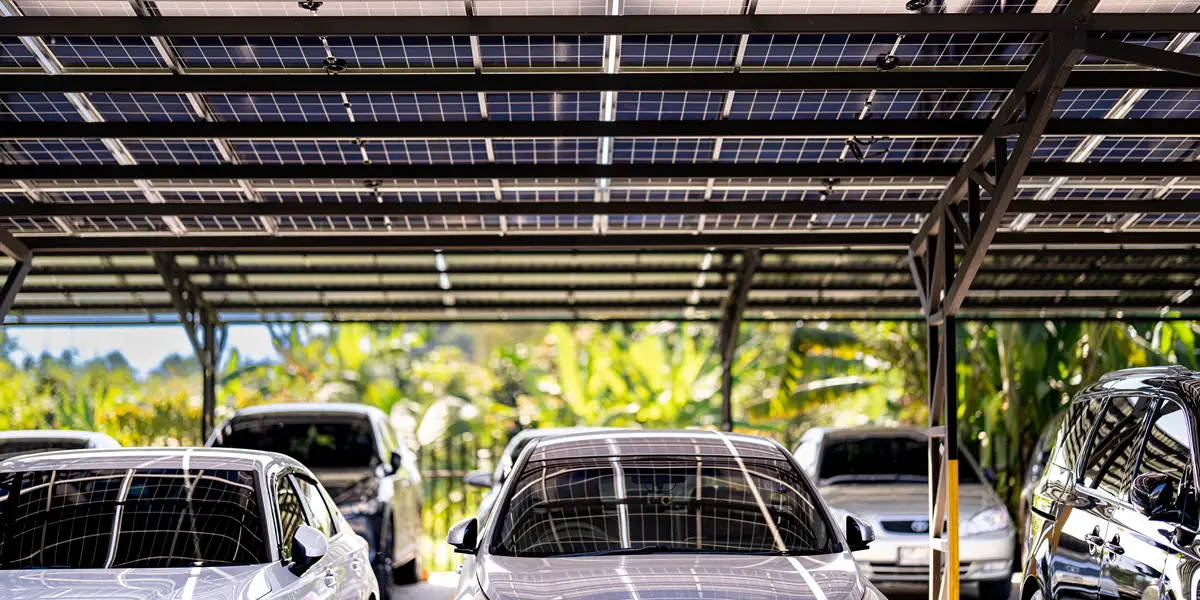
If you have a driveway or car park sitting empty under the sun for most of the day, a solar carport turns that unused space into something genuinely useful. It combines covered parking with a roof of photovoltaic panels, protecting your vehicle while generating electricity for your home or business.
For anyone weighing up a home solar carport against a standard roof installation, the appeal is clear: you get shelter and generation from the same structure. This guide walks through how solar PV canopies work, what they cost, and what to expect from the planning process.
How a Solar Carport Works
A solar carport is built from a steel, aluminium, timber or composite frame, with panels forming all or part of the roof. An inverter converts the electricity the panels generate into a usable form for your home or business, while cabling and an export meter handle the rest of the electrical setup. Because a carport needs its own frame and foundations rather than sitting on an existing roof, the structural build is more involved than a typical rooftop system, which is one of the main factors behind solar carport cost.
The panels are usually set at a shallow, fixed pitch. This makes cleaning and maintenance more straightforward, while the design accounts for wind, drainage and vehicle clearance underneath. If you are still deciding whether a home solar carport suits your property, our guide on what a solar canopy is and whether it’s right for your property is a useful next read.
What Does a Solar Carport Cost in the UK?
Solar carport cost varies depending on the size of the structure and how much groundwork is involved. As a general guide:
- Single-Car Domestic Carport: Roughly £8,000 to £12,000
- Two-Car Domestic Carport: Roughly £15,000 to £20,000
- Domestic Carport with an EV Charger Added: Approximately £14,000 to £22,000
- Domestic Carport with Battery Storage Included: Approximately £18,000 to £30,000
- Small Commercial Installations: From around £40,000 upwards [1]
Commercial canopies covering dozens of parking bays sit at a different scale again, often priced per kilowatt-peak instead of a flat figure. These are indicative figures rather than fixed prices, since foundations, ground conditions and any carport planning permission requirements can all affect the final quote. A proper site survey and itemised quotation will give you a much clearer picture of what your specific project involves, and our team is always happy to talk you through where your budget is likely to land.
The Benefits of Adding a Canopy to Your Parking Space
Once you have a sense of the investment involved, it helps to look at what you get for it. Consider that, with a solar parking canopy, you get more than just electricity generation; it also makes productive use of ground that would otherwise sit idle. This is useful if your roof is unsuitable for panels or you would rather keep it free for other purposes.
And solar canopy benefits extend well beyond generation:
- Weather Protection: Your vehicle stays shielded from rain, frost and bird droppings
- Reduced Heat Gain: Covered parking keeps cars cooler in warmer months
- A Visible Sustainability Feature: Far more noticeable to visitors than panels tucked away on a roof
- Comfort: A more pleasant experience for customers, staff or family arriving and leaving
For businesses, a solar parking canopy also signals investment in lower-carbon operations, valued by customers and staff alike. Solar canopy benefits such as these make the structure far more than a place to park.
Pairing Your Carport with EV Charging
One of the strongest reasons homeowners and businesses consider a carport is how naturally it works alongside EV charging. Fitting a charger to the same structure means your vehicle can draw on electricity generated right above it, reducing how much you need to import from the grid during the day. This pairing is a major part of what makes solar canopy EV charging such an appealing combination for anyone already thinking about switching to electric.
The relationship between generation and demand will not always align perfectly. Solar output naturally dips in winter and disappears overnight, while charging often happens outside daylight hours. Adding a battery or a smart charging setup helps bridge that gap, giving you more flexibility over when your vehicle draws power. It does add to the solar carport cost, but for many households and businesses, the long-term convenience and lower running costs make the combination well worth exploring.
How Much Power Will Your Carport Generate?
Solar carport output depends on several factors: your location, the orientation and pitch of the panels, and how much shading falls across the structure from nearby trees or buildings. A domestic carport in the 4-to-5-kWp range can typically produce somewhere in the region of 3,000 to 4,500 kWh a year, though every site is different and a proper generation estimate should be based on your specific property.
Some installations now use bifacial panels for carport roofs, which capture light on both the front and rear surfaces. Because carport panels sit elevated above a reflective surface such as tarmac or paving, this design captures extra light bouncing back up from below, adding a useful boost to generation. It is worth raising with your installer if you want to get the most from your solar canopy EV charging setup, since higher output means more electricity for your vehicle during the day.
Planning Permission and What to Expect Before Installation
Before any of this generation potential can be realised, your carport needs the right permissions in place. Carport planning permission in England depends on whether your project is domestic or commercial. Many domestic carports fall under permitted development rules for outbuildings, provided they meet conditions around height, position and coverage of the surrounding land [2]. Commercial solar parking canopies have their own permitted development route for non-domestic parking areas, again subject to height limits and distance from neighbouring buildings [3].
Because local restrictions, conservation area status and listed building rules can affect what is allowed, it is worth talking to your local planning authority or an experienced installer before finalising your design. This is exactly the kind of detail our team handles as part of every quotation, so it never becomes a source of delay. Getting this right early keeps your solar carport cost predictable and your installation on track.
Your Next Step Towards a Smarter Driveway
At SESC Solar Service, we design and install bespoke solar carports for homes and businesses across Dorset and the South, backed by MCS certification, NICEIC registration and a lifetime warranty on all our work. Whether you are exploring covered parking, EV charging or both together, our team can talk you through what suits your property. Call us on 01747 445 509 or fill in our contact form to book a free survey.
External Sources
[1] Solar Info, ‘Solar Carports UK: Costs, Types & Installation’: https://solarservice.uk/blog/what-is-a-solar-canopy-and-is-it-right-for-your-property/
[2] Planning Portal, ‘Outbuildings’: https://www.planningportal.co.uk/permission/common-projects/outbuildings/planning-permission
[3] Planning Portal, ‘Solar Panels — Non-Domestic’: https://www.planningportal.co.uk/permission/common-projects/solar-panels-non-domestic/planning-permission-installation-of-a-solar-canopy-on-non-domestic-off-street-parking
Book Your Free Survey Today
Let’s discuss what your property needs — whether it's a new solar installation or an expert check-up.