




Is Solar Thermal Worth It in the UK? An Honest Assessment

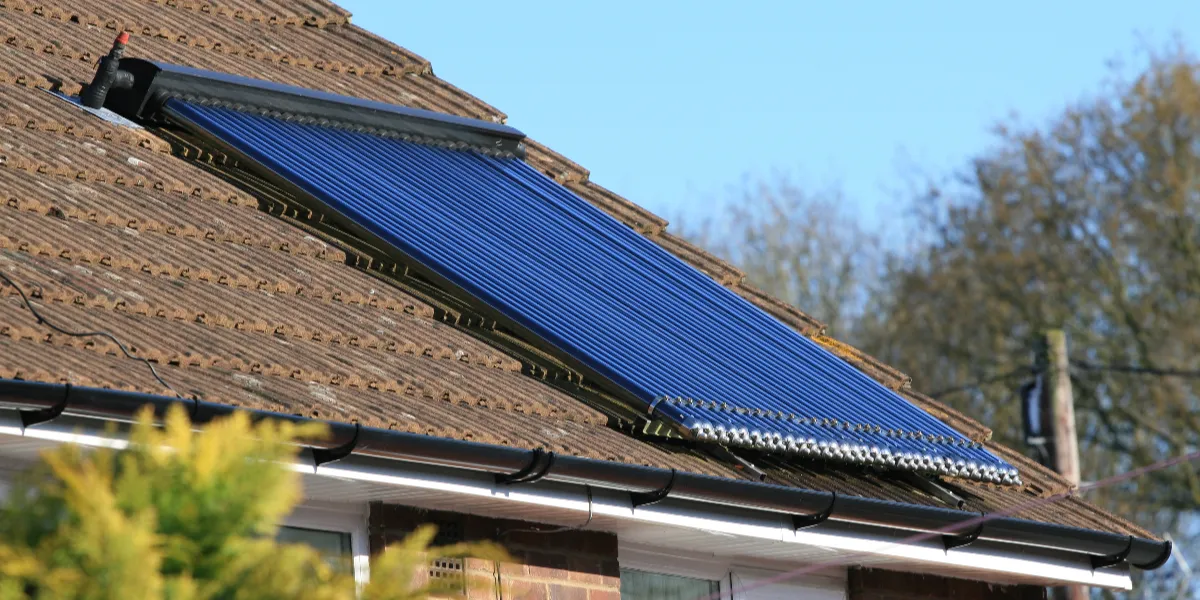
Solar thermal has been heating water in UK homes for decades, but with falling solar PV costs and the closure of the Renewable Heat Incentive, more homeowners are asking whether it still makes financial sense.
So, is solar thermal worth it in 2026? The honest answer depends on your property, your energy costs, and how much hot water your household uses. This guide walks you through everything, so you can make an informed decision.
How Solar Thermal Works
A solar thermal system uses roof-mounted collectors to absorb energy from sunlight. That energy heats a fluid, typically a glycol mix, which circulates through a closed loop and transfers its heat via a coil inside a dedicated hot water cylinder. A pump and controller regulate the flow, ensuring heat is captured when available and stored for use later in the day.
The system reduces the amount of gas, electricity, oil, or LPG your boiler needs to heat domestic water. It does not generate electricity and cannot power appliances. Solar thermal installation in the UK is well established, with systems available in flat-plate or evacuated-tube collector configurations, depending on roof orientation and available space.
Solar thermal efficiency is high when measured purely as heat output per square metre of collector, making it one of the more effective ways to convert sunlight directly into usable energy for the home.
How Much Energy Can Solar Thermal Produce in the UK?
The contribution a solar thermal system makes varies significantly across the year. In summer, when solar irradiance is at its highest, a well-sized system can cover 80-90% of a household’s hot water demand. Over a full year, the realistic figure is closer to 40-60%, depending on collector size, roof orientation, and how much hot water the household uses.
Winter performance is the main limitation. From November through to February, irradiance levels in the UK are low enough that solar thermal contributes relatively little, often below 20% of demand during the coldest months. Your existing heating system remains responsible for making up the shortfall. Understanding this seasonal pattern is important for setting realistic expectations around solar hot water savings. Solar thermal efficiency does not disappear in winter, but it is meaningfully reduced, and any honest assessment of the technology has to account for that.
Typical Costs and Payback Period
Installation costs for a domestic solar thermal system in the UK typically range from £4,000 to £7,000, though the final figure depends on the collector type, system size, and whether a new hot water cylinder is required. If your existing cylinder is not compatible with solar thermal, a twin-coil replacement adds to the overall cost.
In some cases, a full system overhaul makes sense. Our residential installation in Shaftesbury shows how an integrated approach can work in practice.
The solar thermal payback period varies considerably depending on the fuel the system displaces. Homes using electricity, oil, or LPG for water heating will see stronger annual savings than those on mains gas, where the unit cost of energy is lower. In most UK scenarios, payback falls somewhere between 10 and 20 years.
It is also worth noting that the pros and cons of solar water heating differ from those of solar PV: there is currently no government subsidy equivalent to the Smart Export Guarantee for thermal systems, and the Renewable Heat Incentive closed to new applicants in 2022. That absence affects the financial case and should be factored into any decision.
Pros and Cons of Solar Thermal
Solar thermal is a mature technology with a clear role in the right circumstances. Before committing, it is worth weighing both sides.
Solar thermal system benefits:
- Renewable Water Heating with Low Running Costs: The system uses free solar energy to heat water, reducing reliance on fossil fuels and cutting hot water bills. Renewable water heating of this kind produces minimal carbon emissions in operation.
- High Efficiency Per Square Metre: Solar thermal collectors convert a greater proportion of sunlight into usable heat than PV panels convert into electricity, making them well-suited to properties prioritising roof space for hot water.
- Meaningful Summer Savings: A correctly sized system can meet almost all of a household’s hot water demand in warmer months, delivering the strongest solar thermal system benefits across the year.
Limitations to consider:
- Limited Winter Output: Performance drops significantly from late autumn through to early spring.
- Roof Space: Both solar thermal and PV require south or west-facing roof area and are difficult to combine on smaller roofs.
- Cylinder Compatibility: A twin-coil hot water cylinder is required, which adds to the cost if yours needs replacing.
- Ongoing Maintenance: The pump, controller, and glycol fluid all need periodic servicing.
Is solar thermal worth it, given these trade-offs? For the right property, yes. For others, the limitations outweigh the gains.
Solar Thermal vs Solar PV for Hot Water
One of the more significant shifts in recent years is the way solar PV can now effectively contribute to water heating. With a hot water diverter fitted to an existing immersion heater, surplus electricity generated by a PV system can be redirected to heat water rather than being exported to the grid at a low rate. This gives PV a meaningful overlap with what solar thermal does, while also powering appliances, charging batteries, and earning export payments under the Smart Export Guarantee [1].
Solar thermal remains more efficient at directly producing heat. It converts a higher proportion of available solar energy into hot water than a PV system heating water via an immersion element. However, PV’s versatility is a genuine advantage. When assessing the solar thermal payback period against the return on a PV system, many households find that PV offers stronger overall value. Is solar thermal worth it compared to PV? That depends on your priorities. For a detailed comparison of both technologies, SESC’s guide to solar thermal vs solar PV covers the differences in depth.
Solar Thermal vs Heat Pumps
Solar thermal and heat pumps serve different purposes, so it is more useful to understand how they relate to each other than to treat them as direct alternatives. A heat pump provides space heating and hot water, making it a broader replacement for a gas boiler. Solar thermal only heats water.
Where the two technologies intersect is in the solar hot water savings that solar thermal can generate for a home that already has, or is planning to install, a heat pump. Because heat pumps are most efficient when operating at lower flow temperatures for space heating, having solar thermal handle domestic hot water separately can reduce the heat pump’s load and improve its overall efficiency.
The solar thermal vs heat pump question, then, is not always either/or. In homes with high hot water demand and the roof space to accommodate collectors, combining both systems can make practical and financial sense. Heat pumps have a higher upfront cost and serve a broader range of functions, so the right choice depends on whether space heating or hot water is the primary concern.
When Solar Thermal Makes the Most Sense
Solar thermal performs best where the conditions align to maximise output and savings. These situations tend to produce the strongest case:
- High Hot Water Demand: Larger households with consistent daily use will benefit most, as the system has more demand to displace across the year.
- Off-Gas Properties: Homes on electricity, oil, or LPG stand to make considerably greater savings than those on mains gas. The financial case for solar thermal vs heat pump or standalone solar thermal is strongest here.
- Suitable Roof Orientation: A south, south-east, or south-west facing roof with minimal shading provides the best conditions for year-round output.
- Planned Cylinder Replacement: If a cylinder is already due for replacement, upgrading to a twin-coil solar-compatible model adds relatively little to the overall cost.
- Limited Roof Space: When a full PV array is not practical, solar thermal makes efficient use of available roof space.
Is solar thermal worth it for your property? The answer depends on how many of these conditions apply.
Is Solar Thermal Still Worth It in 2026?
Solar thermal remains a practical, low-carbon way to heat domestic hot water, but it works best in specific circumstances. It is not the right choice for every home, but for households with high hot-water demand, off-gas heating, and a suitable roof, it still makes sense. For others, solar PV with a diverter or a heat pump may offer better overall value.
If you are weighing up your options, SESC Solar Service can assess your property and provide a clear, honest picture of which solution best fits your situation. Call us on 01747 445 509 or use our contact form to arrange a no-obligation conversation.
External Sources
[1] Ofgem, “This gives PV a meaningful overlap with what solar thermal does, while also powering appliances, charging batteries, and earning export payments under the Smart Export Guarantee”: https://www.ofgem.gov.uk/environmental-and-social-schemes/smart-export-guarantee-seg
Book Your Free Survey Today
Let’s discuss what your property needs — whether it's a new solar installation or an expert check-up.